The first country in Asia to legally marry its gay community did so on May 24, 2019 — and it built some of the world’s most extraordinary hot springs on top of a volcano while it was at it. Taiwan doesn’t just tolerate queer visitors. It wrote protections for them into law. That distinction matters when you’re deciding where to drop your towel, sink into 42-degree sulfur water, and actually feel at home doing it. The answer is Beitou — a misty, volcano-fed district on the northern edge of Taipei that has been pulling people toward its warmth, its healing, and its particular brand of atmospheric mystery for well over a century.
Steam, Sulfur, and a District With a Dark Past
Long before anyone arrived with a carry-on and a ten-step skincare routine, the Ketagalan Tribe — the area’s original inhabitants — called the Beitou hot springs the “Residence of the Witch,” named for the mist that perpetually swallows the valley. Standing there at any hour, sulphurous clouds rolling off the creek as if the earth itself is exhaling, you understand immediately why. Beitou is one of only two places on the planet where turquoise-colored hot springs are known to contain radium. The chemistry alone makes it singular.
The variety is staggering. Thermal Valley’s geothermal springs run between 50 and 90 degrees Celsius — highly acidic green sulfur springs that mean business. Sulfur Valley’s white sulfur springs sit at a comparatively gentle 45 degrees. Upper Beitou’s iron sulfur springs clock in between 40 and 60 degrees Celsius. This is not a spa hotel with an Instagram-ready plunge pool. This is a living geothermal system beneath a city, bubbling up through rock and memory.
By the early 1900s, Hokuto — the Japanese colonial name for Beitou — had built a thriving, upscale hot spring and entertainment scene, complete with geishas, catering primarily to Japanese and upper-class Taiwanese visitors. That architecture is still standing. Originally constructed in 1911 as the Hokuto Public Bathhouse and designed by Moriyama Matsunosuke in a hybrid Japanese-Western style, the Beitou Hot Spring Museum was once the largest public bathhouse in East Asia. Walking through it now feels genuinely cinematic — tatami lounges, arched corridors, Tudor-style brick and timber, all preserved with the kind of care most cities reserve for cathedrals.
Why Gay Travelers Keep Coming Back to This Particular Hill
Taiwan legalized same-sex marriage in 2019 and has maintained anti-discrimination protections based on sexual orientation since 2003. That legal backbone translates into something you feel the moment you arrive: a baseline of ease. Gay travelers can expect the same dignity and respect as anyone else, along with a range of hotels and venues that are either gay-specific or explicitly welcoming.
Beitou is roughly 20 minutes from central Taipei on the MRT’s red line. Take the red line to Beitou station, transfer to the two-stop pink line, and ride to Xinbeitou — and that shuttle is worth the trip on its own. The themed carriages include a hot spring-style carriage and an art gallery carriage, with installations dedicated to Taiwan and Beitou specifically. It is the rare transit experience that actually builds anticipation.
The gay-friendliness here is not performative. It is quiet, confident, and built into the fabric of a country that has been doing this longer than most of its neighbors have even started the conversation.
Where the Water Gets Gay-Friendly
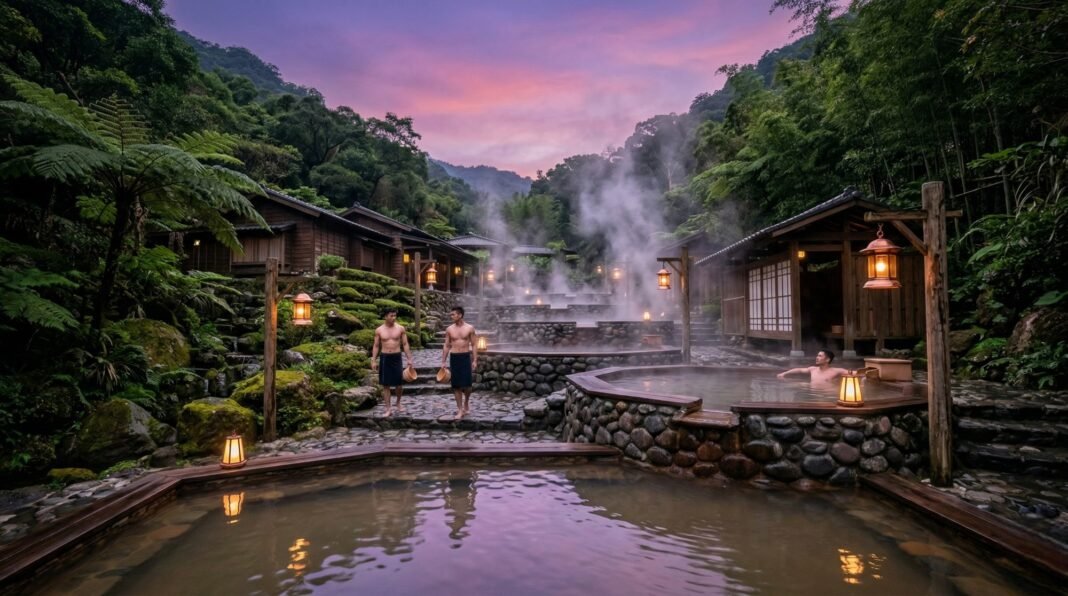
For gay visitors specifically, the Xingyi Road hot spring cluster in Beitou has become a known and welcoming destination. Two spots dominate the conversation. Emperor Spa features multiple pools at varying temperatures and amenities, including one that requires guests to go fully naked. Kawayu Spa — an all-male, all-naked facility decorated in an authentic Japanese onsen style — gets particularly busy in the evenings, especially after 8pm. Its three outdoor pools cover the full range: a large soaking pool averaging 42 degrees Celsius, a round cold whirlpool, and a hydrotherapy hot pool with massaging jets.
What sets Kawayu apart is the open secret that its men’s side has become a well-established gay cruising destination. Nobody pretends otherwise. The atmosphere across Beitou’s water culture is generally relaxed, with locals and tourists mixing freely across pools and temperatures. And if you want to skip the spa scene entirely, Beitou Thermal Valley next door is free, extraordinary, and genuinely one of the more surreal natural sights in Asia — rising steam from hot sulphuric water against a forested valley backdrop.
One practical note for 2026: the Beitou Public Hot Spring is closed for renovations. Spring City Resort is the best alternative — further from the MRT and a touch pricier, but it’s a pleasant 20-to-30-minute walk, the facilities are superior, rules on bathing suits are more relaxed, and robes and towels are provided. Check for updated reopening dates before you go.
Building a Full Day in Beitou
The springs are the headline, not the whole show. Time your visit around the Xinbeitou Historic Station Anniversary in late March to April, the Taiwan Moon Lute Folk Music Festival in September to October, or the Taipei Hot Springs Season in late October to November. Outside of those, March through May is the sweet spot — not too hot, not too cold, and the trees are still heavy with blossoms.
Pack accordingly: speedos rather than swimming shorts (the public baths enforce this strictly), a towel, and flip flops. Build in time for the Beitou Hot Spring Museum, which is free and exceptional — Tudor-style brick and wood construction, black tile roofs, an octagonal window, arched corridors, and the original bathhouse pools and tatami lounges restored with real precision.
Hot springs improve blood circulation, reduce stress, and promote better sleep. That science lands differently when you’re floating in naturally heated mineral water surrounded by forested hills and colonial-era timber architecture. Beitou is where Taipei slows down and reminds you that wellness here is not a trend. It is geology.
Frequently Asked Questions
Are the Beitou hot springs in Taipei actually gay-friendly in 2026?
Genuinely, yes. Taiwan legalized same-sex marriage in 2019 and has had anti-discrimination protections in place since 2003. Gay visitors consistently report feeling comfortable and welcomed throughout Beitou — the ease is real, not curated.
Is the Beitou Public Hot Spring open in 2026?
It’s currently closed for renovations, with Spring City Resort serving as the main public, co-ed alternative open to visitors. Check ahead for updated reopening dates before you finalize your plans.
How do I get to Beitou from central Taipei?
Take the red MRT line to Beitou station, then transfer to the two-stop pink line to Xinbeitou. The hot springs are an eight-to-ten-minute walk from the station exit. Easy.
Beitou has been drawing people into its steaming waters for more than a century. It now does so inside a country with genuine legal protections for queer visitors — something still rare enough in Asia to carry real weight. Whether you’re floating in a 42-degree pool at Kawayu, walking the wooden corridors of a 1911 bathhouse, or watching sulfuric mist rise off Hell Valley at dusk, this is wellness with actual substance behind it. Add it to your 2026 itinerary. For more travel, culture, and lifestyle content written for us, follow Facetheboys and never miss what’s next.