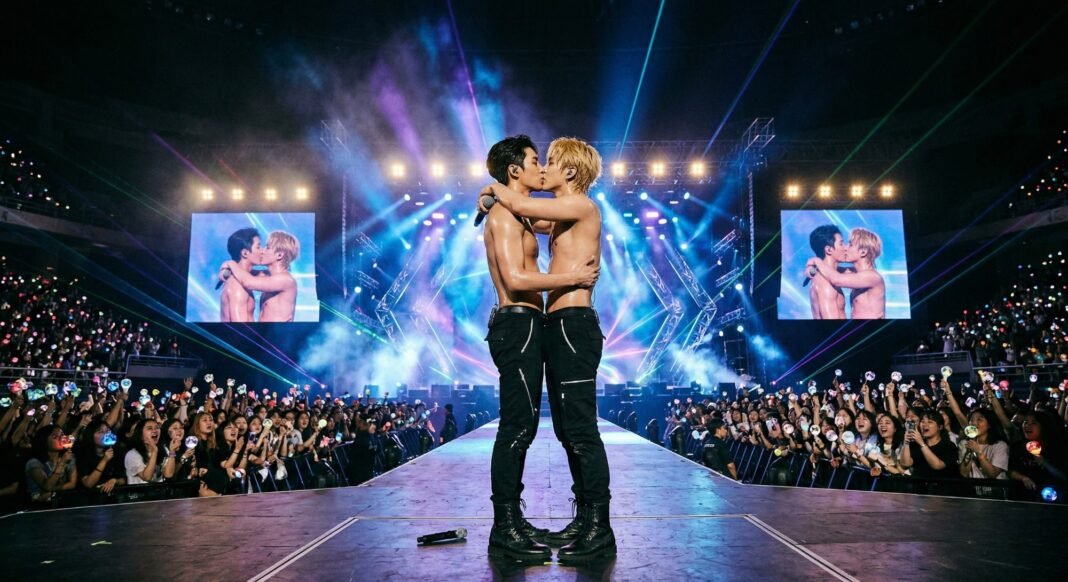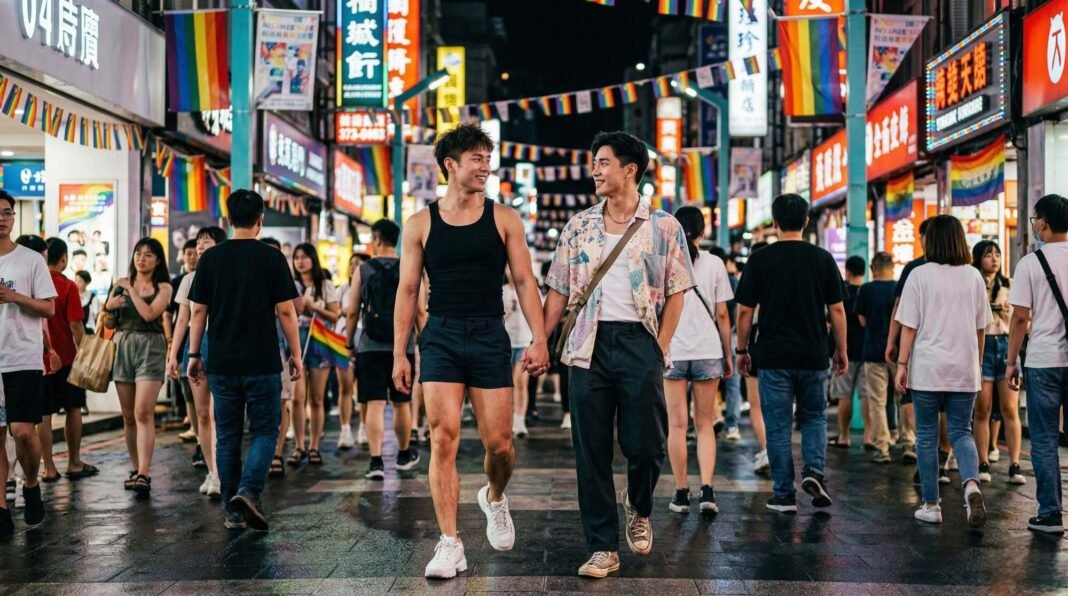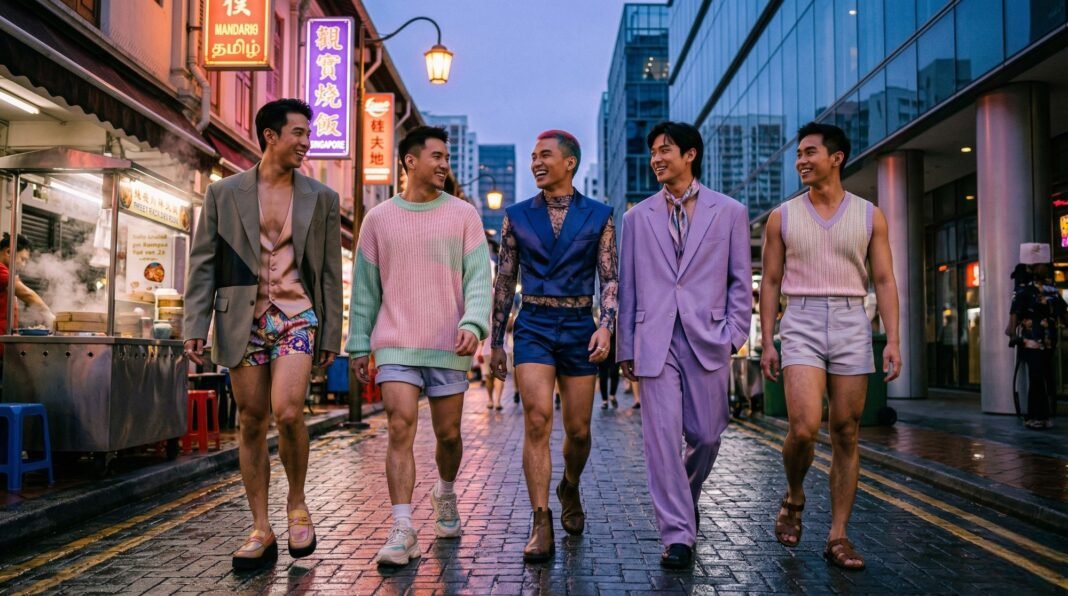
A man in Manchester pairs a pearl choker with a rugby jersey on a Tuesday morning, walks out the front door, and doesn’t think twice about it. That moment — unremarkable to him, seismic in the longer arc of menswear history — is the whole story of 2026.
What marks this year is not the appearance of queer influence in menswear. That influence has been present for decades. What’s new is its full integration into the mainstream. Queer aesthetics have become the operating logic of global street style: not a seasonal trend, but the grammar through which men articulate identity. For gay men, who have been writing that grammar for generations, this moment is both a vindication and an invitation to push even further.
The Shift That Has Been Building All Along
Across the world, in cities whose fashion rhythms rarely align, men are dressing with an unusual freedom, as if some internal lock has clicked open. Silhouettes have softened, hems have risen, and a quiet boldness has seeped into daily wear. The story of 2026 is one of loosening — borders between genders, cultures, and aesthetics dissolving into a single global conversation about how men want to look, and who they imagine themselves becoming.
This did not emerge from nowhere. The border between the queer community and popular fashion has always been porous. Queer style takes from broader culture, remixes it, makes something entirely its own. Then the general public adopts the look once it’s reintroduced as fashionable. The difference in 2026 is that the remix is happening faster, and the credit is, for once, staying closer to its source.
The runways confirmed it in 2025: half-popped collars at Celine, softened tailoring at Tom Ford under Haider Ackermann, tucked-in ties at Saint Laurent and Soshiotsuki, deliberate wrinkles and studied nonchalance at Calvin Klein and Valentino. Scarves and brooches increasingly enhancing, not finishing, a look. Every one of those gestures is a page borrowed directly from queer style’s long, underacknowledged playbook.
What’s Actually in Your Wardrobe Right Now
Beyond the rhetoric, what does this look like when you get dressed in the morning? The skinny jean era is over. Wide-leg “puddle” trousers now dominate, defined by a generous cut and intentionally excessive length — fabric stacking to create that distinctive pool over the shoe. The most sought-after versions arrive in heavy-washed denim, structured corduroy, or fluid technical twill: shape with movement.
Pair those with something unexpected up top. Men’s lingerie has moved from underground subculture to mainstream fashion conversation, and lace, mesh, and sheer styles are redefining what intimate wear even means in a public context. Sheer shirts under structured blazers, linen layered over skin, mesh worn as outerwear — these are not edgy choices anymore. They are simply choices.
Color is having its own quiet revolution. Digital lavender has emerged as a defining hue of 2026 streetwear — a soft, digitally-inspired purple that serves as a backdrop for graphics mimicking digital distortion and AI-generated patterns. For those who prefer their boldness more grounded, color in 2026 functions strategically rather than randomly. It signals emotional range. The point is not to stand out. It is to be seen.
Why Gay Men Are Steering This Conversation
There is a reason the mainstream keeps arriving at places queer communities mapped years ago. Fashion is a language — of self-expression, confidence, and identity. For gay men, style has long been a particularly vibrant form of personal and communal storytelling.
LGBTQ+ consumers are widely recognized as early adopters of new trends, with higher disposable incomes and a deep investment in self-expression through style. But beyond market power, what gay men bring to fashion is a specific fearlessness born of necessity. When dressing yourself authentically has historically required courage, you develop a relationship with clothing that most people never access.
After quiet luxury — muted palettes, discreet branding, studied restraint — something more nuanced has emerged: a desire to dress up without resorting to excess or overt display, this time with a sharp focus on quality everyday staples and the confidence to bring personality to every look. That confidence is something gay men have been practicing since long before it became a trend report headline.
The year’s most significant fashion development, if one can call it that, is not a garment but a gesture: the quiet, assured way men now claim the right to decorate themselves in styles queer communities have championed for generations.
Building Your 2026 Look Without a Rulebook
There is no correct answer here, and that is precisely the point. This approach moves beyond stereotypes to show how functional wardrobe staples, bold stylistic choices, and personal flair come together. Whether you’re refining your everyday rotation, dressing for an occasion, or just experimenting, the goal is intention over obligation.
Start with silhouette. Oversized clothing remains central to streetwear in 2026 — baggy hoodies, loose-fit tees, relaxed sweatpants — offering comfort without sacrificing presence. Gen Z fashion, shaped by TikTok and social media, favors loose, laid-back fits that are easy to style and visually impactful. Stack those roomy proportions against something precise and tailored on top, and you create a natural tension that reads as intentional rather than accidental.
Then accessorize without apology. Interest has shifted away from years of streetwear dominance — logos, tracksuits, sneakers as the primary vocabulary — toward more refined, quality-focused, individualistic styles. A brooch on a denim jacket. A scarf knotted loosely over a hoodie. Pearl hardware on a belt. These details are what make a look yours rather than anyone else’s.
If 2026 teaches us anything, it’s that the future of menswear belongs to those who refuse to choose between softness and strength, subtlety and spectacle. It belongs to the man who steps into the street knowing that what he wears does not define his masculinity — it expands it.
Frequently Asked Questions
What are the biggest queer menswear trends for gay men in 2026?
Wide-leg “puddle” trousers, sheer and mesh layering, softened tailoring, bold accessories like brooches and scarves, and a shift toward quality-focused individualistic dressing are all defining the moment. Queer aesthetics have fully entered the mainstream, making this one of the most exciting years for self-expressive menswear in recent memory.
How can I start dressing more expressively without overhauling my whole wardrobe?
Start with one statement accessory — a pearl choker, a brooch, an unexpected scarf — and build from there. Confidence is the real foundation of any look, so pick one piece that genuinely excites you and let the rest of your outfit support it rather than compete with it.
Are queer-owned fashion brands worth seeking out specifically?
Absolutely. Brands built within the queer community tend to understand the nuance of self-expression in ways mainstream labels don’t always capture. From established names to independent designers, shopping queer-owned labels is both a style choice and a way to keep money circulating within the community.
The closet door isn’t just open in 2026 — it’s been off its hinges for a while, and the rest of the world is finally catching up. For gay men, this is not a trend cycle to observe from the sidelines. It is a conversation we started, one that rewards anyone willing to dress with genuine intention rather than quiet compliance. Wear the lace. Stack the trousers. Brooch the blazer. The moment is yours. For more queer culture, style, and community coverage, follow Facetheboys and stay in the conversation.