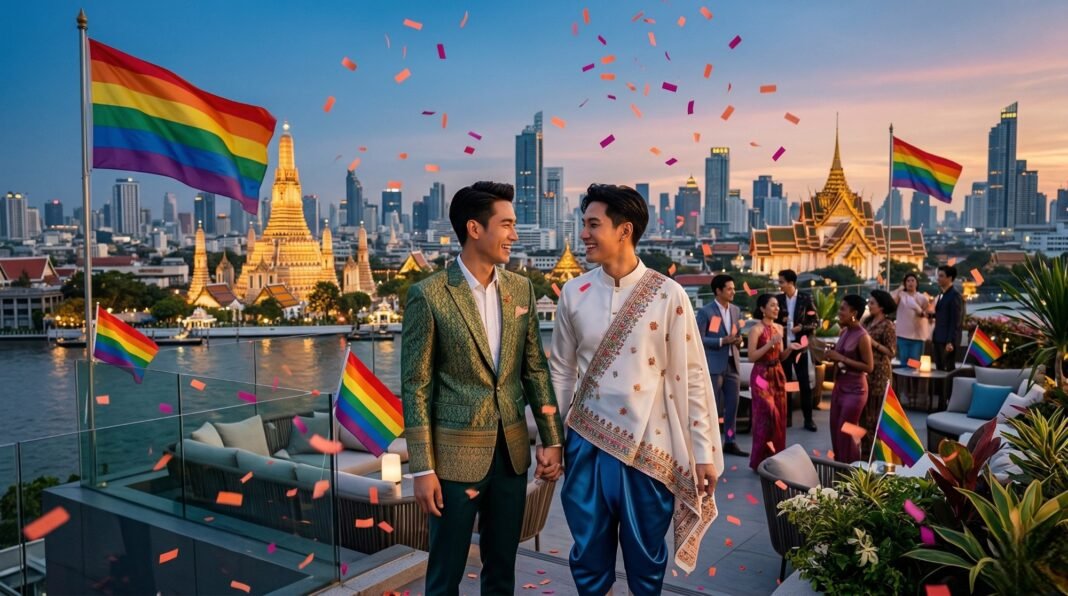
Thailand didn’t just crack open a door for LGBTQ+ couples — it blew the whole thing off its hinges. By January 2026, 26,287 same-sex couples had married in Thailand, accounting for about 10% of all marriages. Let that number sink in. One in every ten marriages registered in the Kingdom is a same-sex marriage. That’s not a footnote in a policy document — that’s a cultural shift playing out in real time at district offices across an entire country.
How Thailand Made History — and Meant It
The Civil and Commercial Code Amendment Act, commonly referred to as the Marriage Equality Act, made Thailand the first country in Southeast Asia and the second in Asia to legalize same-sex marriage, after Taiwan. The road there was longer than it should have been — civil partnership bills stalled, parliaments dissolved, activists kept fighting — but when the vote finally came, the House of Representatives passed it 400 to 10, and the Senate approved it 130 to 4. Those are not close numbers. That’s a nation speaking with one voice.
The act received royal assent from King Vajiralongkorn on 12 August 2024, was published in the Royal Gazette on 24 September 2024, and came into effect on 23 January 2025. That first day was electric. On January 23, 2025, 1,832 same-sex couples registered their marriages nationwide. At Siam Paragon’s Marriage Equality Day celebration alone, 185 couples tied the knot in front of LGBTQ+ couples, Thai celebrities, and diplomatic representatives — including officials from the Taipei Economic and Cultural Office, representing Taiwan, Asia’s first territory to legalize marriage equality.
What “Equal” Actually Means Under This Law
This law is not a symbolic gesture dressed up in legal language. It went deep into the civil code and rewrote the rules from scratch. The legislation replaced “men and women” and “husband and wife” in the Civil and Commercial Code with “individuals” and “spouses,” and it allows same-sex couples to jointly adopt children. That language shift isn’t cosmetic — it signals that the law treats all couples as structurally identical, not as a special category carved out beside the norm.
The UN Human Rights Office for South-East Asia welcomed the act, which ensures equal rights regardless of gender identity and sexual orientation, spanning medical care, property, inheritance, taxation, and adoption. For gay men especially, the inheritance and medical decision-making provisions are transformative — these are the rights that matter most during life’s hardest moments. Spousal benefits, including health insurance and retirement pensions, must also be equally available to employees in same-sex marriages. Employers are required to comply. This isn’t optional.
The Numbers Behind the Celebrations
Of the 26,287 same-sex couples married by January 2026, 24% were male couples and 76% were lesbian couples. That’s a striking gender split worth paying attention to. It mirrors patterns seen elsewhere — lesbian couples have tended to formalize relationships at higher rates, at least in the early years after marriage equality passes.
Bangkok Pride has cautioned that official figures may not fully capture lived realities, since the current registration system classifies couples based on sex assigned at birth rather than gender identity. Many transgender individuals may not be accurately reflected in government data, meaning the real number of LGBTQ+ marriages could be higher than the statistics suggest.
Beyond the romance, the economic story is striking. A 2025 study commissioned by travel company Agoda projected that the Marriage Equality Act will create 152,000 full-time jobs and increase Thailand’s GDP by 0.3%. The law is also projected to attract an additional 4 million tourists annually and generate approximately $2 billion in revenue. Love, as it turns out, is very good for business.
The Work That Still Needs Doing
Thailand deserves its flowers — and it also deserves honesty. Bangkok Pride has noted that approximately 50 related laws still require amendment, and delays in revising them continue to create practical barriers for LGBTQ+ couples seeking full and equal access to their rights. A marriage certificate is only as powerful as the systems built around it.
One pressing issue is gender recognition for transgender individuals. Despite Thailand’s widely known cultural openness around gender diversity, the country still does not legally allow individuals to amend their gender on official documents. That’s a significant gap. Being able to marry as who you are — on paper — matters enormously for trans couples navigating a legal system that still doesn’t fully see them.
Gaps between legal progress and lived experience persist. UNDP’s Tolerance but Not Inclusion study reports that half of LGBTI people interviewed experience discrimination within their own families, and 41% of LGBTI students and 61% of transgender women reported discrimination at school. Changing a law is the first chapter, not the last. But Thailand has at least started writing — and that matters in a region where most countries haven’t picked up the pen yet.
Frequently Asked Questions
Is same-sex marriage in Thailand legal for foreign couples in 2026?
Yes. Foreign couples can register their marriage in Thailand regardless of gender, but must provide proof they are not already married.
What rights do same-sex married couples have in Thailand?
Quite a few. The law grants same-sex couples the right to adopt children, inherit property, make medical decisions for each other, share property, and access spousal benefits including health insurance and retirement pensions.
Where can same-sex couples register their marriage in Thailand?
At any of Thailand’s 878 provincial district offices, Bangkok’s 50 district offices, or at 94 Thai embassies and consulates worldwide — so you don’t even have to be in the country to make it official.
Thailand’s marriage equality story is one of the most genuinely exciting developments in global LGBTQ+ rights in years — 26,000 couples and counting, a law with real teeth, and a country still pushing for more. It’s not perfect, but it’s real, it’s growing, and it’s proof that progress in this part of the world is possible. For more stories that matter to gay men living boldly and living well, follow Facetheboys — we’re here for every chapter.