This Content Is Only For Subscribers
Leo Chen had life mapped out: pre-med, dean’s list, a future that would make his immigrant parents beam. His world was a carefully ordered constellation of organic chemistry formulas, library cubicles, and the quiet loneliness of being the “good son” in a family that never spoke of the things that lurked in the shadows of the heart. Then, in his second year at Pacific Ridge University, a new star flared into his orbit.
Min Jun-seo arrived from Seoul with a storm of quiet intensity. He was a transfer student in Leo’s Comparative Literature seminar, a painter who used words like brushstrokes. Where Leo was all structured certainty, Min was all evocative questions. Their first real conversation happened in the rain, under the inadequate shelter of the humanities building’s overhang. Leo, fumbling with a broken umbrella, offered to share. Min simply looked at the downpour and said, “Why run? It’s just water.” They stood there, shoulders almost touching, as the world blurred around them.
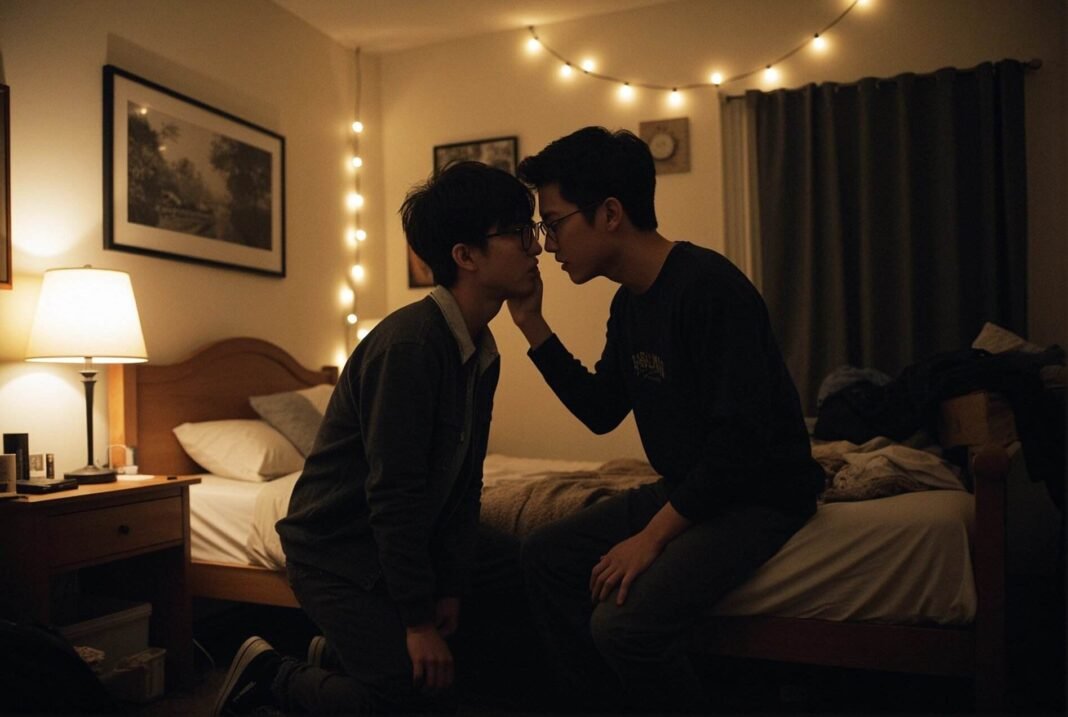
Friendship was a slow, sweet burn. Study sessions in Leo’s tidy dorm room stretched into late-night talks. Min would read passages from Rumi or Ocean Vuong, his voice a low, melodic rumble that vibrated in Leo’s chest. Leo would explain the Krebs cycle, and Min would laugh, calling it “the poetry of existence, written in carbon.” Leo found himself memorizing the curve of Min’s smile, the way his ink-stained fingers curled around a coffee cup, the faint scent of sandalwood and rain that clung to his clothes.
The tension built in the space between sentences, in lingering glances across a crowded café, in the accidental brush of hands when passing a book. For Leo, it was a terrifying freefall. Every desire felt like a betrayal of the future his parents had sacrificed for. For Min, it was different but no less daunting; he carried the weight of being the only son, the expectation to continue the family line back in Korea.
The turning point came during a weekend trip to a cabin in the Cascades with a few friends. The others had gone to town, leaving Leo and Min alone by the fireplace. The silence was thick, charged. Min was sketching in a notebook. “Can I draw you?” he asked, his voice barely above a whisper.
Leo nodded, his throat tight. He sat on the rug, trying to be still as Min’s eyes traced over him with an artist’s focus—and something more. The only sounds were the crackle of fire and the soft scratch of charcoal on paper. After what felt like an eternity, Min put the sketchbook down. He didn’t show Leo the drawing. Instead, he crossed the room and knelt in front of him.
“Leo,” he said, the name a prayer. “The space between us… it’s killing me.”
And then Min kissed him.
It was not a gentle first kiss. It was a dam breaking. It was all the unsaid words, the suppressed longing, the fear and hope crashing together. Leo’s careful world shattered. He kissed back, hands coming up to cradle Min’s face, fingers tangling in his dark hair. They sank to the rug, a tangle of limbs and desperate touches. Clothes were pushed aside, not ripped, but urgently discarded. The firelight painted their skin in gold and shadow.
Leo learned the geography of Min’s body—the scar on his shoulder from a childhood fall, the sensitive spot just below his ear, the way his back arched when Leo touched him just right. Min mapped Leo’s tensions and fears with his lips and hands, worshiping him like a revelation. It was clumsy and perfect, a fusion of heat and whispered names, of pain and overwhelming pleasure that felt like being remade. Afterward, they lay entwined, skin slick with sweat, listening to each other’s hearts slow. No words were needed. The truth was in their tangled legs, in Min’s head resting on Leo’s chest.
The real world rushed back in with the dawn. The bliss of the cabin weekend gave way to the complex reality of their lives. There were awkward moments in public, stolen kisses in empty stairwells, and the constant, low-grade fear of being seen. Leo’s grades slipped. His mother noticed the distance in his weekly calls. Min started getting pressure from his family about meeting a nice Korean girl.
The conflict climaxed during spring break. Leo’s parents made a surprise visit. He and Min were in Leo’s dorm, half-dressed, lost in each other, when the key turned in the lock. The look on his mother’s face—a fracture of shock, hurt, and dawning understanding—was worse than any anger. The silence that followed was a chasm. Min left quickly, his dignity a fragile shield. The confrontation with his parents was quiet, devastating. His father’s disappointed, “Is this why we came to America?” felt like a physical blow.
For a week, Leo was adrift. He ignored Min’s texts, wallowing in guilt and shame. It was Min who finally forced the reckoning. He found Leo at their usual spot by the library pond. “You have a choice,” Min said, his eyes fierce with unshed tears. “You can live in the space they made for you, or you can build your own. But you don’t get to build it without me. Not after this.”
It was the hardest thing Leo had ever done. He went home that weekend and sat with his parents. He didn’t shout or cry. He spoke, haltingly, in a mix of Mandarin and English, about the loneliness of the path they’d chosen for him, and the profound, anchoring love he’d found in Min. It wasn’t a tidy resolution. There were tears, there was silence, but the door was left ajar, not slammed shut.
Graduation came. Min got accepted into a prestigious MFA program on the East Coast. Leo, after much turmoil, switched his major to biomedical engineering—a field that thrilled him, not just his parents. On their last night in the dorm, surrounded by packed boxes, Min finally showed Leo the sketch from the cabin. It was Leo, but not as he saw himself. It was Leo rendered in light and shadow, his guard down, his eyes full of a longing he hadn’t yet admitted to himself. It was a portrait of love seen, and recognized, before the subject even knew it was there.
“I’ll follow you,” Leo said, tracing the charcoal lines of his own face.
“I know,” Min replied, and kissed him. “We’ll make our own space. Between the stars.”