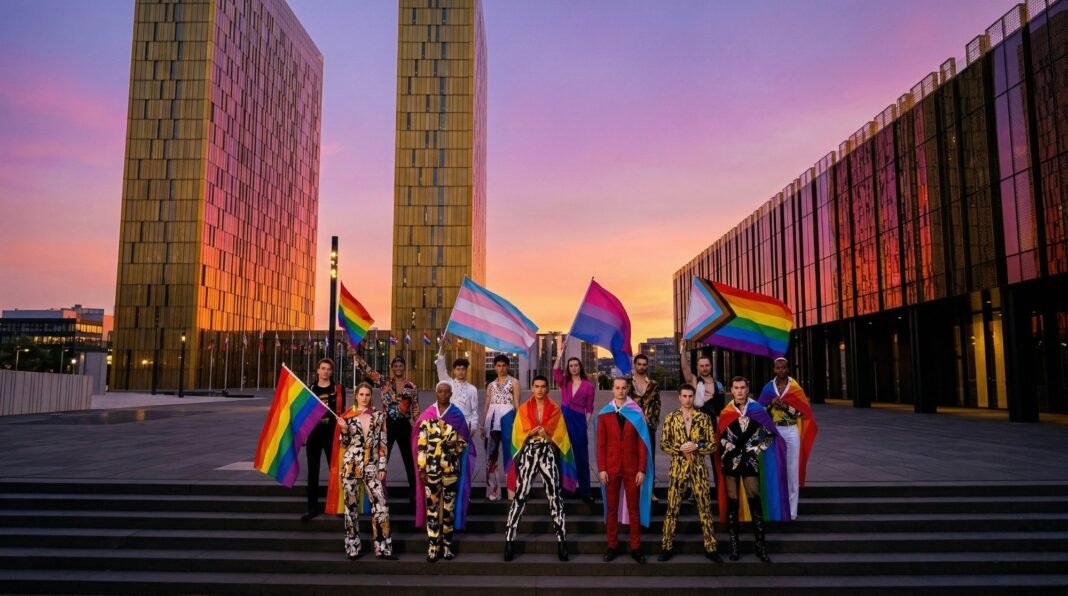
Somewhere in Europe right now, a trans woman is carrying identity documents that do not reflect who she is — because a national government decided it knew better than she does. That just became a lot harder to legally justify. In March 2026, the Court of Justice of the European Union sent a message to all 27 member states sharp enough to leave a mark: when it comes to the rights of LGBTQ+ citizens, EU law is not a suggestion.
What the Court Actually Decided
On 12 March 2026, the EU’s highest court ruled that member states must allow transgender people to legally change their name and gender on identity documents. The case centered on a Bulgarian trans woman identified in proceedings as “Shipova,” who had spent nearly a decade fighting Bulgarian courts for the simple right to have her gender and name updated on her ID — and being denied.
The legal reasoning was pointed. The court ruled that recognising a trans person’s gender identity is a fundamental right within the EU, binding on all member states under their human rights obligations. It went further: the ruling nullifies any Supreme Court judgment that restricts legal gender recognition, including Bulgaria’s own 2023 Supreme Court decision banning lower courts from updating gender markers on legal documents.
That is not a nudge. That is a direct override.
The court also stipulated that member states must maintain “clear, accessible and effective procedures” for gender recognition to ensure EU rights function in practice — not just on paper. The ruling applies to all 27 member states, Hungary included, which banned trans people from correcting their official documents back in 2020.
This ruling arrives alongside another seismic moment from just months earlier. On 25 November 2025, the Court of Justice ruled that member states must recognise same-sex marriages lawfully concluded in another EU country. The decision stops short of requiring states to legalise same-sex marriage domestically, but it demands that recognition be applied — in the court’s own words — “without distinction or additional hurdles.”
The Backlash the Courts Are Pushing Back Against
To understand why these rulings matter, you have to understand what they are up against. ILGA-Europe, the Brussels-based LGBTQ+ human rights organisation, found that by 2025, propaganda and misinformation had hardened into formal policy: cutting civil society funding, imposing de facto bans on organisations, and misusing courts and administrative powers to target communities and criminalise individuals.
Hungary is the EU’s most extreme case. In 2025, Pride marches were prohibited outright — the first EU member state to reach that particular low — with laws allowing facial recognition surveillance against participants. Bulgaria, Hungary, and Slovakia are the three EU states that have either heavily restricted or flatly banned legal gender recognition.
The resistance to ECJ authority has precedent. Romania, Poland, Slovakia, Hungary, and Bulgaria all ignored the previous two ECJ rulings on same-sex marriage recognition. Viktor Orbán has not been subtle about his position. In his State of the Nation address, he declared: “We must not yield, we must not give up on protecting our children. Dragging us before a court in Luxembourg will be of no use to them.”
That is exactly the environment these rulings are landing in. Which is precisely what makes them matter.
The Green Shoots: Where Progress Is Real
It would be easy to read this as a purely grim story. But genuine progress is happening.
In Poland, the final remaining LGBTI-free zone resolution was repealed in 2025, closing a long chapter of state-sponsored discrimination. Then, in March 2026, Poland’s Supreme Administrative Court ruled that public authorities must recognise same-sex marriages performed in other EU countries — following the ECJ’s November obligation to do so regardless of what domestic law permits.
The shift is meaningful. A country that spent years carving itself into an archipelago of LGBTQ-exclusion zones is now legally compelled to recognise the marriages of same-sex couples who wed across the border. The ECJ ruling — grounded in the right to freedom of movement and family life — “sets the standard on same-sex marriage across the EU,” as one legal expert noted, meaning “people can refer to that judgment and then expedite their ability to get their rights recognised and protected.”
Even in Hungary, defiance cuts both ways. Budapest Pride in June 2025 drew nearly 200,000 people — a record attendance — demonstrating that suppression was generating its own counter-pressure. You can ban a march on paper. You cannot ban a community.
What the Courts Can and Cannot Do
Courts can rule. They cannot enforce. And the gap between a judgment in Luxembourg and the lived reality of a trans person in Budapest or Sofia remains painfully wide.
Civil society groups argue EU-level action is still inconsistent, with reforms still needed in anti-discrimination law and protections for intersex and transgender people. ILGA-Europe has criticised the European Commission’s 2026-2030 LGBTQ+ equality strategy as significantly less ambitious than its predecessor — it contains no clear action on intersex rights and no commitment to ban conversion practices.
There is also the broader democratic context. A Liberties Rule of Law report, drawing on evidence from 40 human rights organisations across 22 EU countries, documents a serious, deliberate erosion of the rule of law in five member states, including Bulgaria, Croatia, Hungary, Italy, and Slovakia. Increasingly hostile political rhetoric toward the judiciary and human rights institutions risks corroding public confidence in those institutions — and in the legal standards they are supposed to uphold.
And yet the courts keep ruling. Activists keep litigating. Communities keep marching, even when marching is criminalised. “Thousands of trans people in the EU are breathing a sigh of relief today,” said TGEU’s Richard Köhler following the March ruling. That relief is real, even if the fight is nowhere near finished.
Frequently Asked Questions
What did the EU court ruling on trans rights in 2026 actually decide?
The Court of Justice of the European Union ruled that national legislation failing to provide a pathway for legal gender recognition is incompatible with EU law. Member states must allow transgender people to update their name and gender on official identity documents — and must provide clear, accessible procedures to make that possible.
Does the EU ruling on same-sex marriage mean all EU countries must now legalise it?
No. The November 2025 ruling does not require any member state to change its domestic marriage laws. What it does require is that each member state recognise same-sex marriages legally performed in another EU country — no exceptions, no extra hoops.
Which EU countries have the worst records on LGBTQ+ rights right now?
Bulgaria, Hungary, and Slovakia stand out as the states with the most restrictive legal gender recognition regimes, and all three failed to implement the majority of EU rule of law recommendations. Hungary is in a category of its own: it has banned Pride events, restricted official gender recognition since 2020, and deployed facial recognition technology against people attending LGBTQ+ assemblies.
Two landmark rulings in under six months. A record Pride crowd in a city where Pride is technically illegal. A Polish Supreme Administrative Court finally falling into line. None of this is a victory lap — the opposition is organised, well-funded, and in several cases writing the actual laws. But the EU court system has now established, twice over, that LGBTQ+ rights are not a national opt-out. They are a European legal standard. The fight to make that mean something in practice is the defining civil rights story of this decade. Stay across every development with Facetheboys — follow us for coverage that does not look away.