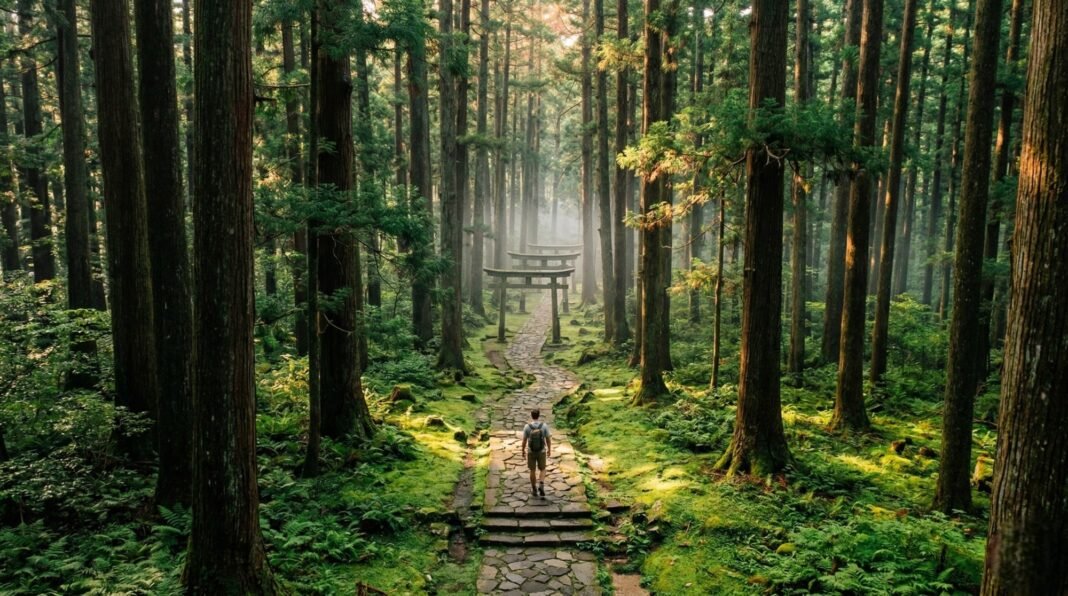
Your nervous system is begging you to go outside — and science has the receipts. Two hours in a forest measurably lowers your blood pressure, drops your stress hormones, and sends your immune system into overdrive. No gym membership. No app subscription. No protein powder. Just trees, fresh air, and the discipline to put your phone away. Japan figured this out four decades ago. The rest of the world is only just catching up.
Born From Burnout — The Origin Story of Shinrin-Yoku
By the 1970s, Japan was fraying at the edges. Rampant urbanisation and a culture of extreme overwork had driven a sharp rise in anxiety and stress-related illness. The Japanese even coined a word for the worst-case scenario: karoshi, which translates literally as “overwork death,” describing sudden occupational mortality. The country needed a remedy, and it needed one that came without a prescription pad.
In 1982, Japan’s Minister of Agriculture, Forestry, and Fisheries, Akiyama Tomohide, officially introduced shinrin-yoku as part of a national program promoted by the Japan Forest Agency. The goal was to use the forest environment as a direct tool for workers’ health. Not a spiritual retreat. Not a weekend hobby. A public health initiative, written into government policy.
The term itself is elegant in its simplicity. Shinrin means “forest.” Yoku means “bath.” Together: bathing in the forest atmosphere, or taking in the forest through the senses. The concept has deep roots in Japan’s Buddhist and Shinto traditions, but the modern framework dates to that 1982 government coinage. With two-thirds of the country covered in forest and a vast diversity of trees, Japan made the practice not just philosophically logical but geographically convenient. Since 2006, the Forest Therapy Society has registered official “forest therapy bases” across the country — from snowy Hokkaido to tropical Okinawa — with 62 certified locations now on the list, each vetted for environmental quality and tested for measurable impact on visitors’ health.
The Science Behind the Stillness
Here is where it gets genuinely compelling, especially for anyone who has dismissed a slow walk in the woods as too passive to matter.
Studies show that two hours of mindful exploration in a forest reduces blood pressure, lowers the stress hormone cortisol, and improves concentration and memory. Trees release chemicals called phytoncides, which carry a protective antimicrobial effect and boost the immune system. Shinrin-yoku increases natural killer cell activity, NK cell count, and intracellular levels of anti-cancer proteins — findings that suggest a preventive effect on cancers. Those are not wellness blog talking points. That is peer-reviewed immunology.
The mental health results are equally striking. In the Profile of Mood States test, shinrin-yoku reduces scores for anxiety, depression, anger, fatigue, and confusion, while increasing vigor — results that point toward preventive effects on depression.
The benefits do not evaporate the moment you step back onto the pavement, either. Japanese researchers have shown the relaxing effects can last up to five days after a single session. A 2021 study in South Korea found that participants who attended weekly forest-therapy programs for eight weeks maintained significant reductions in perceived stress and improvements in sleep quality compared with a control group. A 2026 review published in PubMed went further still, summarising evidence of forest bathing’s effects on immune function, stress physiology, and neuroprotective pathways. The field of Forest Medicine — researchers use the term with a straight face and a strong dataset — is expanding fast.
Why the Gay Community Should Be Paying Attention
Wellness culture has long held space for the queer community, and for good reason. Chronic stress, health anxiety, and the compounding weight of moving through the world as a queer person are real and well-documented. Shinrin-yoku offers something refreshingly low-barrier and evidence-backed in return.
Research indicates the practice reduces mental health symptoms in the short term, particularly anxiety. For communities that carry disproportionate mental health burdens, documented results like these deserve more than a passing trend cycle.
There is also something quietly radical about a wellness practice that asks nothing of you except your presence. No hiking pace to maintain. No output to track. Shinrin-yoku is simply being in nature, connecting with it through sight, hearing, taste, smell, and touch. In a culture that often tells queer people their bodies must perform, optimise, and conform, the invitation to exist in a forest without agenda is, in itself, a form of resistance.
Forest bathing also demonstrates measurable anti-aging effects through reductions in cortisol and inflammatory markers, enhanced immune function via increased natural killer cell activity, and decreased oxidative stress. Emerging evidence links it to slowed telomere shortening, suggesting cellular rejuvenation. That last point alone should be enough to close every skincare browser tab and start searching for the nearest forest trail.
How to Actually Do It — And Do It Right
The good news: shinrin-yoku requires almost nothing. Spend time among trees and grass, mindfully engaging with a forest atmosphere at a slow, gentle pace, without electronics, soaking up whatever nature surrounds you.
The key word is slow. This is not a hike with a destination. There is no summit, no calorie count, no achievement to post. Give yourself time without rushing. The goal is to relax and let go.
Use all five senses. Observe the colours and shapes of nature. Listen to the wind and the animals. Smell the fresh plant scents. Touch the bark. Breathe deeply, move calmly, and resist any urge to plan your route.
You do not need to be in Japan to feel the effects. Research confirms that shinrin-yoku in city parks produces real health benefits, making this accessible to urban dwellers who cannot easily escape to old-growth forest. Central Park, Hampstead Heath, Griffith Park, the Bois de Boulogne — wherever you are, there is almost certainly a patch of trees within reach that is quietly ready to do something extraordinary for your nervous system.
For a more structured introduction, the California-based Association of Nature and Forest Therapy Guides and Programs has trained over 800 guides leading groups in shinrin-yoku across 48 countries. A guided session is a particularly good entry point for anyone who finds it difficult to slow down alone — which, honestly, describes most of us.
Frequently Asked Questions
What exactly is Japan shinrin-yoku forest bathing and how is it different from a regular walk in the woods?
Think of it as the difference between eating and actually tasting your food. Shinrin-yoku is a deliberate, slow, sensory immersion in a forest environment — not exercise, not hiking, not step-counting. The goal is mindful presence using all five senses, with no destination and no heart rate target required.
How long do you need to practice forest bathing to see health benefits?
Research points to two hours as a meaningful threshold — enough time to produce measurable reductions in blood pressure and cortisol. Better still, studies show the calming effects can persist for up to five days after a single session, which is a remarkable return on a Sunday afternoon.
Do you have to go to Japan to experience shinrin-yoku properly?
Not even close. While Japan maintains 62 certified forest therapy bases, research confirms that urban parks produce meaningful health benefits too. Any accessible green space can serve as your starting point. The trees near you are already doing the work — you just have to show up.
Japan did not stumble onto shinrin-yoku by accident. It was a deliberate, government-backed response to a nation burning itself out, and four decades of science have confirmed it works. Lowered cortisol. Stronger immune cells. Improved sleep. Reduced anxiety. Potentially slower cellular ageing. All of it from slowing down among trees. If your wellness routine does not yet include scheduled time in nature, consider this your sign. Follow Facetheboys for more on the culture, science, and travel stories shaping how we live, feel, and thrive.