Fifty people showed up to the first Seoul Queer Culture Festival in 2000. Some onlookers cursed and yelled at them. In 2026, organizers are expecting a crowd more than 3,000 times that size. Twenty-six years is a long time, but the arc of this festival — from a small, harassed gathering on a single street in Daehangno to one of Asia’s most significant queer cultural events — is genuinely extraordinary. The 2026 edition is shaping up to be the most anticipated one yet.
From 50 People to a City-Wide Movement
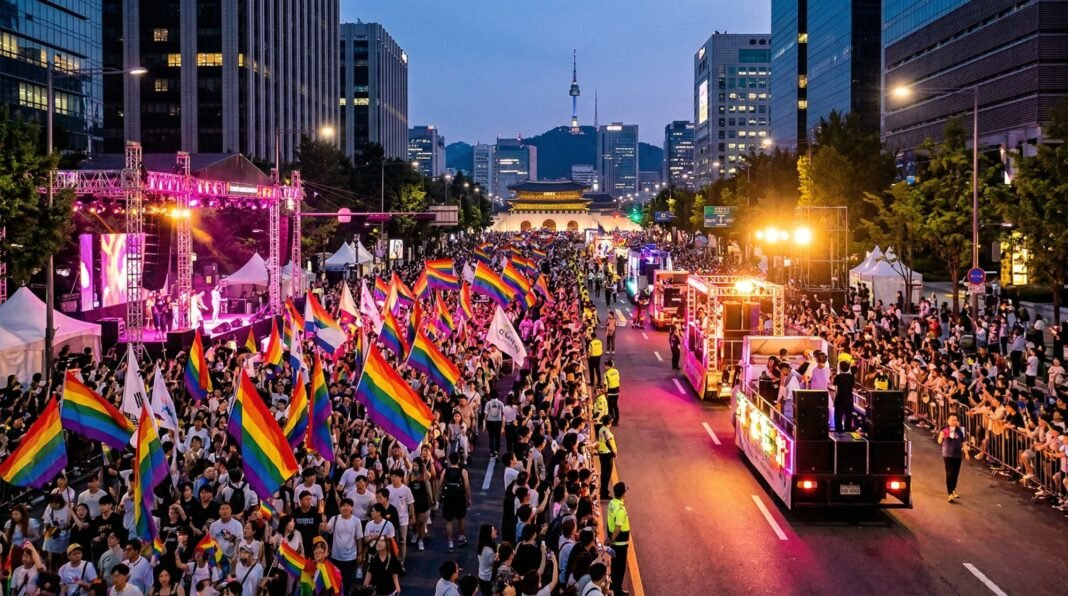
What began as an almost invisible act of defiance has grown into something its founders could not have imagined. The Seoul Queer Culture Festival — known as SQCF — launched in 2000 with around 50 participants. By 2024, over 150,000 people packed Seoul’s downtown Euljiro area for the 25th edition, a record at the time. Then 2025 arrived and broke it: more than 170,000 people took to the hot asphalt of central Seoul, sexual minorities and allies side by side, to make themselves undeniable.
The 2026 edition is the 27th. Organizers expect at least 150,000 participants. Given recent trends, that number reads more like a floor than a ceiling.
What the Festival Actually Looks Like
The SQCF is not an afternoon in a park. It’s a week or two of open cultural programming, built around the vision of “creating a space where all people with diverse identities, including sexual orientation and gender identity, mingle equally and enjoy.” The festival typically runs from late May into early June, culminating in the Seoul Queer Parade on the final Saturday — Korea’s biggest pride parade, where tens of thousands move through central Seoul in rainbow-colored garments and flags, past some 70 promotional booths lining streets normally full of cars.
The parade draws a genuinely eclectic crowd: politicians, farmers, foreign envoys, celebrities, and civic groups from across the country. It is loud, it is colorful, and it is packed. But the festival extends well beyond that single Saturday. The Korea Queer Film Festival runs concurrently, aiming to expand diversity in Korean cinema and shed light on queer life and human rights. Art exhibitions, workshops, and screenings exploring love, identity, and activism fill out the calendar. There is a lot to do, and it all means something.
The Politics Behind the Party
Writing about the SQCF honestly means talking about what organizers have had to fight through to keep it going. This festival does not exist in a frictionless cultural vacuum.
For the second consecutive year in 2024, the SQCF could not hold its event at Seoul Plaza — the venue it had used since 2015 — after the city government rejected the permit application. The Seoul Metropolitan Government, led by conservative Mayor Oh Se-hoon, cited a scheduling conflict. Conservative Christian groups, calling themselves the “holy seawall,” have staged counter-rallies across the street from Seoul City Hall, denouncing the festival and protesting a proposed anti-discrimination bill. No injuries have been reported during the event.
And yet: the community keeps coming back larger than the year before. SQCF organizing committee chairperson Yang Sun-woo said it plainly — “The festival will always go on, somewhere in the city center.” That defiant continuity is arguably what makes the SQCF worth paying attention to. It is not just a celebration. It is a recurring, very public insistence on visibility. For 2026, the Seoul Queer Parade is still confirming its route and location to accommodate the growing crowd, so check official channels as the date approaches.
Plan Your Seoul Pride Trip
If you’re seriously thinking about making the trip, start planning early. The festival window of late May to early June fills up fast — both in terms of flights and accommodation. Seoul is well-connected internationally: Incheon Airport handles nearly all international arrivals, while Gimpo serves domestic and some regional routes. Both are linked to the city by train, with English information available throughout.
For the scene beyond parade day, two neighborhoods are essential. Homo Hill — a small pedestrian street in Itaewon dotted with cafes, shops, restaurants, and bars — is where most of the post-parade energy lands. It’s closest to Itaewon Station Exit 2, about a five-minute walk after turning right off the main street. Expect great bars with street views, strong pours, and a crowd that runs the full spectrum of locals, travelers, and expats, making it one of the most welcoming and interesting gay scenes in Asia. Hongdae offers a different flavor: underground clubs and rooftop terraces, younger crowds, louder music.
One thing worth knowing before you go: unlike many comparable events worldwide, this festival actively limits photography and video by attendees. Respect that policy. Not everyone in that crowd is out in their daily life, and that boundary matters.
Frequently Asked Questions
When is the Seoul Queer Culture Festival 2026?
The festival typically runs for one to two weeks in late May to early June. Exact 2026 dates and venues haven’t been confirmed yet, so bookmark sqcf.org and check back as the festival approaches.
How many people attend the Seoul Queer Culture Festival?
The 2025 edition drew over 170,000 people — a new record. The 2026 edition is expected to bring at least 150,000 participants, including LGBTQ+ people and allies, though recent momentum suggests the final number could be higher.
Where does the SQCF pride parade take place?
The parade route and location for 2026 are still being confirmed, partly to accommodate the growing number of attendees. Your best source for updates is the official SQCF website and social channels.
From 50 people braving hostility on a single street in Daehangno to a multi-week festival drawing hundreds of thousands into the heart of one of Asia’s great cities — the Seoul Queer Culture Festival is one of the most remarkable stories in global queer culture, full stop. The 2026 edition will be the 27th, and by every measure it is going to be massive. Whether you go for the parade, the film festival, the nightlife, or simply to stand in a crowd that enormous and feel the full weight of what it represents — this one belongs on your calendar. Stay connected with Facetheboys for more LGBTQ+ travel, culture, and community stories from around the world.